

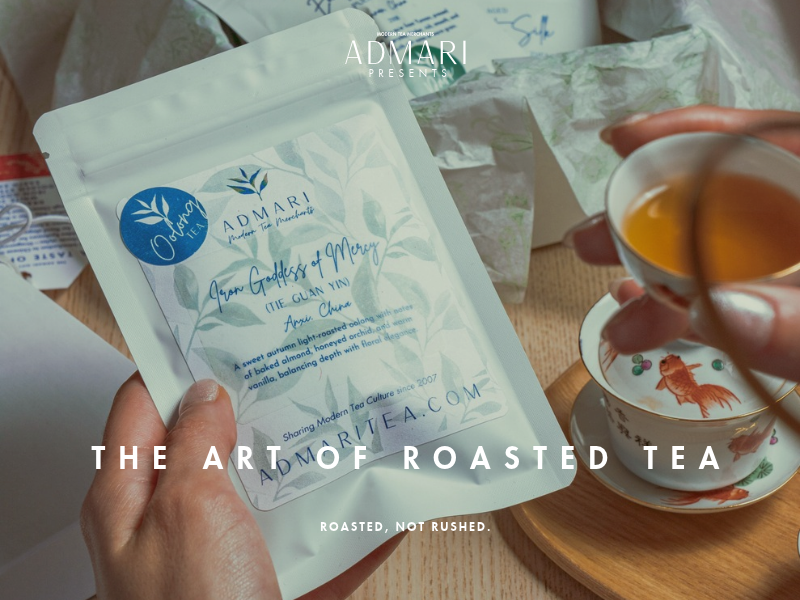
Join us for an exploration of what happens when tea meets heat.
Roasting can completely transform a tea, but it is only one of several ways heat is used in tea making. In this two-hour workshop, we’ll explore the differences between drying, firing, baking and roasting, and look at how each can shape aroma, sweetness, texture, body and finish.
Through guided tastings spanning Japanese roasted teas and Chinese oolongs, we’ll explore different expressions of heat, from lighter, more leaf-forward teas to deeper, more integrated roasts. We’ll look at how roasting interacts with a tea’s original character, why some teas are baked or roasted repeatedly, and how time, temperature, moisture and resting all influence the finished cup.
We’ll also explore the chemistry behind roasted flavor, including the Maillard reaction and the development of aromas that can remind us of toasted grain, roasted nuts, cocoa, baked fruit and deeper caramel-like sweetness.
And we’ll put some of that theory into practice by re-roasting an aged Yan Cha. Here, heat serves another purpose entirely: reducing accumulated moisture and helping maintain the tea as it continues to age. It’s an opportunity to see why returning a finished tea to heat is not always about making it taste “more roasted.”
What to Expect
Taste Japanese roasted teas and Chinese oolongs with different expressions of heat and roast.
Learn the practical differences between drying, firing, baking and roasting, and why those terms are not interchangeable.
Explore lighter and deeper roast styles and learn how heat can either support or overwhelm the original character of the leaf.
Understand how time and temperature work together, and why a long, gentle bake can create a very different tea from a shorter, hotter roast.
Explore why some teas are roasted once while others are baked or re-roasted repeatedly over time.
Watch an aged Yan Cha being re-roasted as we explore moisture management, resting and the role of heat in maintaining teas for aging.
Learn about charcoal roasting and modern roasting methods, and why the heat source alone does not determine the quality of a finished tea.
Explore the Maillard reaction and some of the chemistry behind the toasted, nutty, baked and roasted aromas created through heat.
Build a practical sensory vocabulary for recognizing the effects of roast, from fresh and floral to toasted grain, nuts, cocoa, baked fruit and deeper roasted notes.
Learn to distinguish what belongs to the original leaf from what has been developed or transformed through heat.
By the end of the class, you’ll have a clearer understanding of why tea makers use heat, how different approaches to roasting and baking create different results, and how to recognize the influence of those decisions in the cup.
The goal of roasting is not simply to make tea taste roasted. It is to understand the leaf well enough to know how much heat to use, for how long, and for what purpose.
Come taste what happens when leaf meets fire.
Reserve your spot today and discover what heat can reveal in a tea. Limited spots available; early registration is highly recommended.